Volume & Issue: Volume 2, Issue 1 - Serial Number 3, Spring 2026 
Number of Articles: 6

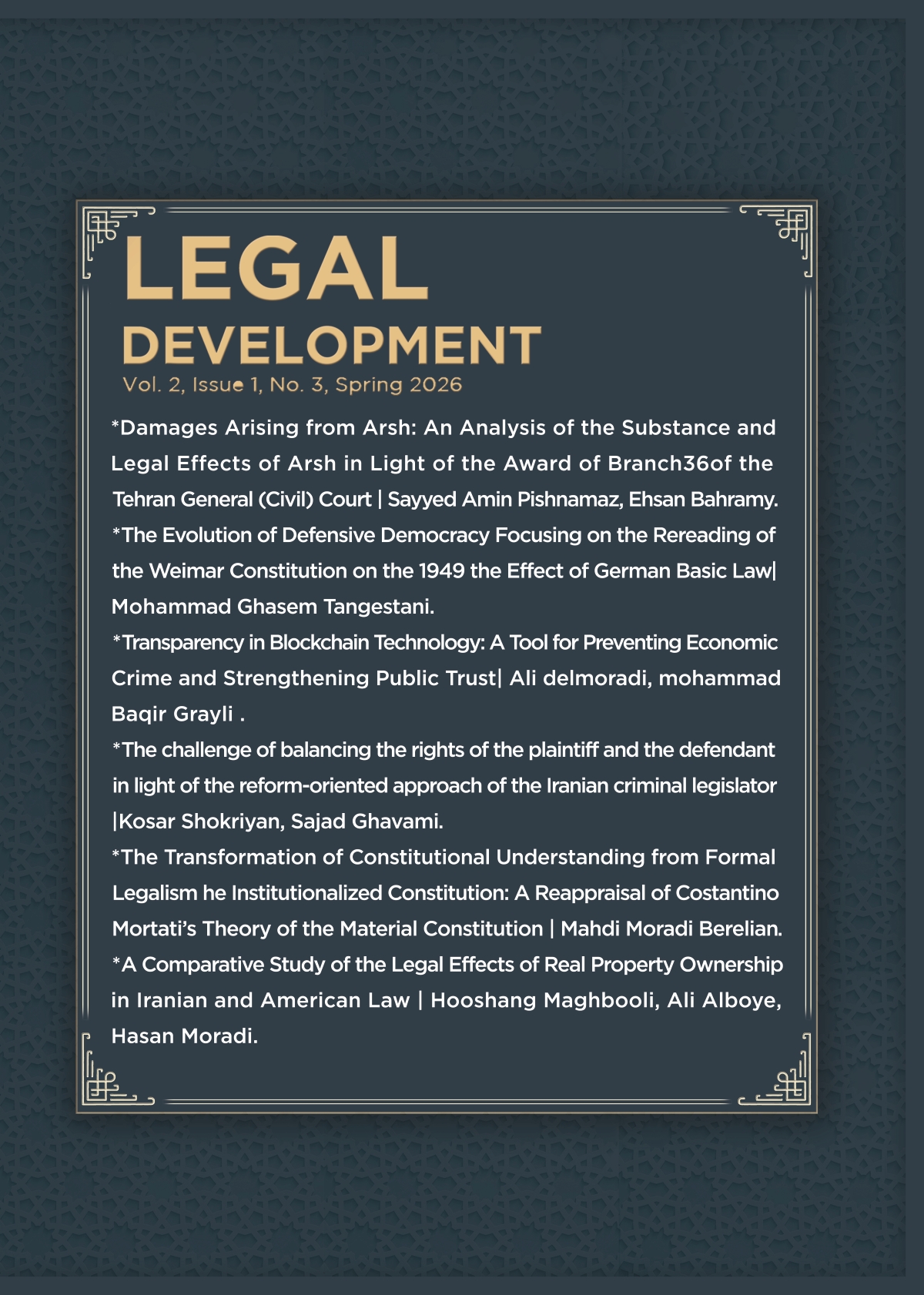
Damages Arising from Arsh: An Analysis of the Substance and Legal Effects of Arsh in Light of the Award of Branch 36 of the Tehran General (Civil) Court

https://doi.org/10.22080/law.2026.736941

Sayyed Amin Pishnamaz, Ehsan Bahramy

Abstract The award issued by Branch 36 of the Tehran General (Civil) Court, in the course of adjudicating a claim for recovery of Arsh, default damages for delay in payment, and litigation costs, incidentally addresses the nature of Arsh and certain rules and effects arising from its determination. The court, reasoning that Arsh itself constitutes a form of damages, declined to award damages for delay in payment of Arsh. On the other hand, the court rejected as unfounded the defenses raised by the defendant’s counsel regarding the extinguishment of Arsh as a consequence of the waiver of all options, and, relying on the opinion of a three-member expert panel, ordered the defendant to pay Arsh resulting from the defect. The present study examines, through a descriptive–analytical approach, the legal nature of Arsh and the issue of its extinguishment following the waiver of the option of defect. The characterization of Arsh as either compensation for loss or as performance of an obligation arising from Exchange Liability has a decisive impact on its legal rules and effects. If Arsh is regarded as damages, an award of default damages for delay in payment would face limitations such as the requirement of prior ascertainment of the amount of damages and the prohibition on awarding damages upon damages. Conversely, if the payment of Arsh is viewed as the performance of an obligation grounded in Exchange Liability, its nature would not be compensatory damages, but rather a mechanism for restoring equilibrium and balance between the reciprocal contractual obligations. In this latter case, once Arsh is claimed by the entitled party, reliance on the doctrine of warranty of possession, instead of the rules of destruction (itlāf) or causation (tasbīb), may preclude the occurrence of loss arising from delay in payment or non-performance of Arsh.

The Evolution of Defensive Democracy Focusing on the Rereading of the Effect of the Weimar Constitution on the 1949 German Basic Law

https://doi.org/10.22080/law.2026.736942

Mohammad Ghasem Tangestani

Abstract Although the Weimar Constitution is often identified in the public memory of European constitutional law with the failure of democracy, the rise of National Socialism, and the erosion of parliamentarism, its impact on postwar German constitutional law was not merely negative and alarming. The main issue of this research is how the 1919 Constitution, despite the historical collapse of the Weimar Republic, played a role in the development of the 1949 German Basic Law and the formulation of the model of defensive democracy. The present study, using a descriptive-analytical and historical-institutional method, shows that the Basic Law reinterpreted and reconstructed the Weimar experience at three levels: textual, institutional, and judicial. At the textual level, through the integration of some Weimar articles into Article 140; at the institutional level, through the primacy of human dignity, fundamental rights, the Federal Constitutional Court, and the limitation of anti-democratic parties; and at the judicial level, through the interpretation of the free democratic order and the formulation of criteria for prohibiting or limiting anti-constitutional parties. The research findings are that Weimar was not just a memory of failure for post-war German fundamental rights, but also an institutional memory through which German democracy evolved from a merely open and defenseless democracy to a law-abiding, rights-based, and self-defending democracy. However, this article shows that defensive democracy remains compatible with constitutionalism only if it is itself subject to due process, reasoning, proportionality, and institutional constraints.

Transparency in Blockchain Technology: A Tool for Preventing Economic Crime and Strengthening Public Trust

https://doi.org/10.22080/law.2026.737406

Ali Delmoradi, Mohammad Baqir Grayli

Abstract This article systematically analyzes the role of transparency in blockchain technology as a new and transformative strategy in the field of non-criminal prevention of economic crimes. Given the cross-border, hidden, and complex nature of financial crimes in the digital age, which has created numerous challenges for traditional judicial systems, this research explores how the inherent and distributed transparency feature of blockchain can act as an efficient tool in two layers of situational and social prevention. The research method in this study is descriptive-analytical and analyzes the different dimensions of this phenomenon by utilizing reliable legal, criminological, and specialized texts in the field of information technology. The results of this research show that structural transparency in blockchain helps prevent economic crimes in two strategic ways. First, from a situational prevention perspective, this technology, with its permanent, real-time, and immutable transaction traceability, creates powerful technical and regulatory barriers to criminal activities such as money laundering, tax evasion, and corruption, effectively reducing opportunities for crime. Second, from a social prevention perspective, blockchain restores public trust in governance institutions and economic processes by providing a transparent, democratic, and auditable financial ecosystem for all actors, thereby weakening the psychological and social incentives to engage in criminal behavior. Finally, this article concludes that leveraging the transparency capabilities of blockchain is a comprehensive, proactive, and efficient approach to combating economic crime that can address the shortcomings of traditional centralized systems and pave the way for a healthier, safer, and more just financial environment.

The challenge of balancing the rights of the plaintiff and the defendant in light of the reform-oriented approach of the Iranian criminal legislator

https://doi.org/10.22080/law.2026.733610

Kosar Shokriyan, Sajad Ghavami

Abstract In recent years, those involved in our country's judicial system have tried to benefit from new ‎scientific and empirical achievements in enacting criminal laws and regulations, paying special ‎attention to new developments in the fields of criminology and penal science. This attention, ‎especially in some areas, has led to the introduction of institutions such as suspension of ‎punishment, postponement of sentencing, and conditional release into the country's penal ‎system, with the influence of the teachings and discourses of international criminal law and ‎modern criminology. On the other hand, in some cases, our legislation, due to the influence of ‎Sharia and social requirements, has defined institutions such as pardon and repentance as tools ‎on the path of reform and rehabilitation of criminals. The main goal of these measures has been ‎to reform the behavior and rehabilitation of criminals, and the legislator has tried to guide the ‎country's penal system towards rehabilitation and reform, focusing on protecting the rights of ‎the accused. However, this focus has sometimes been such that the necessary balance between ‎the rights of the plaintiff and the accused has been disrupted. In such a way that some of the ‎rights of the plaintiffs of crimes have been weakened in the new laws and in some cases have ‎even been damaged. Therefore, it can be said that the recent criminal legislation has become a ‎law that protects the accused rather than creating a proper balance between the rights of the ‎parties. Ultimately, this trend reflects the challenge that legislators face; a challenge that requires ‎reviewing and creating a logical balance between the rights of the accused and the plaintiff so ‎that the country's criminal system, while maintaining justice, can also achieve the goals of ‎reform and rehabilitation.‎

The Transformation of Constitutional Understanding from Formal Legalism to the Institutionalized Constitution: A Reappraisal of Costantino Mortati’s Theory of the Material Constitution

https://doi.org/10.22080/law.2026.735987

Mahdi Moradi Berelian

Abstract The crisis of European constitutional law in the interwar period was not merely the collapse of parliamentarism or the failure of liberal states; rather, it was a crisis in the legal understanding of the constitution itself. The formal constitution, understood in the liberal tradition as a supreme legal document and an instrument for limiting power, lost its explanatory force in the face of mass parties, executive concentration, social polarization, and the transformation of sovereignty. This study aims to explain the emergence of the concept of the “material constitution” in interwar Europe and to analyze its relationship with the crisis of constituent power, the transformation of the state, and institutional order.

The study employs a descriptive-analytical method with a historical-conceptual approach. Costantino Mortati’s theory is reappraised within the theoretical field shaped by Hans Kelsen, Carl Schmitt, Rudolf Smend, and Hermann Heller, so that the constitution may be understood not merely as a text, but as the point of intersection between norm, power, institution, and society.

The findings show that Mortati’s theory, despite its connection with a historically and politically problematic context, provides a way beyond the simple dualism between Kelsenian normativism and Schmittian decisionism. For Mortati, the material constitution neither negates the formal constitution nor submits to the raw reality of power; rather, it refers to the institutional and social layer that sustains the constitutional text.The significance of the theory of the material constitution lies in revealing the gap between the written constitution and the institutional reality of power. It shows that a constitution without institutional and social support may remain formally valid yet practically ineffective. However, the material constitution can serve constitutionalism only when accompanied by the rule of law, separation of powers, fundamental rights, and accountability. Mortati’s main contribution is thus the opening of a path toward “institutionalized constitutionalism

A comparative study of the effects of ownership of real estate in Iranian and American law

https://doi.org/10.22080/law.2026.736940

Hooshang Maghbooli, Ali Alboye, Hasan Moradi

Abstract چکیده
مفهوم آثار مالکیت در حقیقت به نتایج و پیامدهای حقوقی، اقتصادی و اجتماعی ناشی از مالکیت اشاره دارد. زمانی که فردی به‌عنوان مالک شناخته می‌شود، این مالکیت آثاری در پی دارد که شامل حقوق، تعهدات، محدودیت‌ها و مسئولیت‌های گوناگون است. نظام‌های ثبتی یکی از ابزارهای مهم در تضمین امنیت حقوقی مالکیت اموال غیرمنقول محسوب می‌شوند. در ایران و آمریکا، هر کدام از این نظام‌ها با روش‌ها و شیوه‌های متفاوتی اقدام به ثبت مالکیت می‌کنند. نظام‌های ثبتی به‌عنوان یکی از ارکان اصلی تأمین امنیت حقوقی در مالکیت اموال غیرمنقول، نقش بسزایی در حفظ و حمایت از حقوق مالکانه افراد دارند. در این مقاله، تأثیر نظام‌های ثبتی ایران و آمریکا بر امنیت حقوقی مالکیت اموال غیرمنقول مورد بررسی و مقایسه قرار می‌گیرد. در ایران، نظام ثبت املاک بر مبنای سند رسمی و قانون ثبت اسناد و املاک مصوب 1310 استوار است که هدف اصلی آن جلوگیری از اختلافات ملکی و تضمین حقوق مالکیت است. در مقابل، نظام ثبتی در ایالات متحده آمریکا بر اصل مالکیت خصوصی و ساختارهای فدرالی و ایالتی متعدد بنا شده است که تفاوت‌هایی در رویه‌ها و سازوکارهای آن وجود دارد. این پژوهش ضمن بررسی نقاط قوت و ضعف هر یک از این نظام‌ها، به تأثیر آنها بر تضمین امنیت حقوقی، کاهش دعاوی ملکی، و تقویت اطمینان سرمایه‌گذاران پرداخته و پیشنهاداتی برای بهبود نظام ثبت املاک ایران ارائه می‌دهد.