Evolution of Property Law in the Digital Context: EU Legal Doctrine and the Iranian Legal Approach

Pages 2-33

setare Ayoubi, Sam Mohammadi, Seyyed Hasan Hosseini Moghaddam

Abstract One of the defining characteristics of the digital age is the accelerated pace of communication and the role of the Internet as the gravitational centre of global information. This connectivity, in addition to bringing individuals closer together, has enabled the interaction and overlap of various technologies, including social media algorithms and machine learning systems. These developments have led to fundamental transformations in the concept of property law. Digital property rights encompass access to and control over digital information, data, internet accounts, as well as contractual and intellectual property rights in the digital sphere. This study aims to examine the evolution of property law in the digital context within the European Union and to analyse its legal doctrine with a view to proposing solutions for the enhancement of digital property law in Iran. The research question is as follows: how have the policies and regulations
of the European Union and Iran concerning digital property evolved? The findings indicate that over the past two decades, EU policy on digital technologies has shifted from a liberal economic approach towards a legal doctrine grounded in digital currencies. This transformation arises from the emergence of the information society, which has created new opportunities and challenges for fundamental rights and democratic values. The adoption of the Regulation on Markets in Crypto-Assets (MiCA) in September 2020 exemplifies the EU’s effort to regulate and manage digital assets through legal frameworks. In contrast, Iran still lacks a clear legal framework for crypto-assets, and such assets are traded on the market without legal oversight. An examination of the EU’s legal doctrine can serve as a model for improving the Iranian legal system with respect to digital property. Conducted through a descriptive-analytical method, this study, while examining EU legal doctrine, offers recommendations for its adaptation to Iranian law.

The Assassination of General Zahedi from the Perspective of International Human Rights Law

Pages 34-53

Misagh Bagheri, Moahamd Setayeshpur

Abstract This research aims to conduct a legal and human rights‑based analysis of the assassination of General Mohammad Reza Zahedi in the airstrike carried out by the Israeli regime against the consular section of the Iranian Embassy in Damascus. It seeks to examine this incident within the framework of peremptory norms of international law (jus cogens), the prohibition of the use of force, and States’ extraterritorial obligations to protect the right to life. The necessity of this study arises from the fact that extraterritorial targeted killings have emerged in recent years as a serious challenge to the international legal order, undermining the foundations of human rights and collective security. The central research question is: from the standpoint of the international human rights law system, which fundamental obligations does the assassination of General Zahedi violate, and how can the responsibility of the acting State be established? This study adopts a descriptive‑analytical approach, relying on international instruments, judicial and arbitral jurisprudence, United Nations reports, and legal doctrine. The findings indicate that the action constitutes a clear instance of arbitrary deprivation of life, a violation of the principle of non‑intervention, a breach of the inviolability of diplomatic premises, and a violation of Article 6 of the International Covenant on Civil and Political Rights (ICCPR). Moreover, it may be characterised as a form of State terrorism. The research concludes that the operation violated absolute and non‑derogable human rights obligations, exposes the acting State to international responsibility, and underscores the urgent need to strengthen legal accountability mechanisms at the international level.

Assignment of Claims in Iranian Law with a Comparative Look at French and English Law

Pages 54-70

Mehrdad Pakzad, Mohammad Farzanegan, Mohammad MehdiPur

Abstract Assignment of claims has long been a subject of interest in the legal systems of developed countries. This article examines and compares assignment of claims in Iranian law with a view to the laws of England and France. Using a descriptive‑analytical method and library‑based research, the study explores the similarities and differences between Iranian domestic law and the two foreign legal systems. The Iranian legislator, particularly in the Civil Code, has not specifically addressed assignment of claims. Only through the general principles of other contracts can certain conclusions be drawn, although some jurists have equated this institution with novation under Article 292 of the Civil Code. Nevertheless, a clear legislative gap exists in our statutes. While not discussed in Islamic jurisprudence (fiqh), assignment of claims does not conflict with sacred Sharia law. By its nature, elements, conditions, and related legal concepts — including novation through substitution of debtor, suretyship (zamān), assignment of debt (hawalah), bills of exchange, insurance, and factoring — assignment of claims is fundamentally distinct. Therefore, the specific provisions governing those legal acts cannot be extended to assignment of claims; rather, it has an independent nature and requires dedicated rules. In English law, assignment of claims was initially opposed for religious reasons, but it was eventually accepted and has gained recognition in commercial instruments and international trade. In French law, assignment of claims is accepted, and the new reformed Civil Code has devoted detailed provisions to it.

A Comparative Study of the Role of the Time Element in the Structure of the International Responsibility of States

Pages 71-92

seyyed Hadi Pazhouman

Abstract This article provides a comparative examination of the concept and role of the time element within the structure of the international responsibility of States. Adopting an innovative approach, the study analyses the time element as a key axis in the structure of international responsibility, moving beyond the traditional conception of prescription as merely a procedural bar to the admissibility of claims. The primary objective is to elucidate the multifaceted role of time at all stages of the formation, attribution, justification, and reparation of international responsibility. Using a comparative-analytical method and examining the jurisprudence of the International Court of Justice (ICJ) as well as Articles 12 to 15 of the International Law Commission (ILC) Draft Articles on Responsibility of States for Internationally Wrongful Acts, the research demonstrates that time is not only significant in determining the moment of attribution of a wrongful act and the temporal compatibility of an obligation with an act, but also decisive in assessing circumstances precluding wrongfulness (force majeure, distress, necessity) and in calculating damages (delay and interest). The central finding of the research is that the time element constitutes a structural component in the architecture of international responsibility, defining the legitimacy, the invocation, and the limits of reparation. Consequently, despite the absence of a formally established institution of prescription in international law, the temporal dimension implicitly – yet fundamentally – shapes the entire process of implementing responsibility and ensures the stability and justice of the international legal system. Thus, while prescription is still not a well-established institution in international law, the time element plays a fundamental role in all stages of the formation, justification, and enforcement of international responsibility, and its explication extends beyond the traditional framework of prescription in law.

Revisiting Civil Liability Attribution for Organizational Use of Intelligent Contract Management Systems

Pages 93-113

Zeinab Tari, Mohammad Hossein Taghipour Darzi Naghibi

Abstract The increasing deployment of artificial intelligence systems in organizational contract management has challenged traditional models of civil liability. In such systems, risk assessment, clause evaluation, and contractual recommendations are conducted through algorithmic processes that may become structurally integrated into the formal decision-making framework of legal entities. When harm occurs, classical doctrines—whether based on individual fault, vicarious liability, or liability arising from things—do not always adequately address the complexity of technology-driven decision-making. Focusing on the organizational use of intelligent contract management systems under Iranian law, and distinguishing between contractual and non-contractual liability, this article examines how liability should be attributed where non-contractual harm occurs. It argues that when an AI system plays an effective and systematic role in the formation of a legal entitys will, the resulting decision is directly attributable to the organization itself, without disregarding the fault-based foundations of Iranian civil liability law. In such cases, liability analysis must be conducted at the structural level of the entitys decision-making framework. Accordingly, a theory of organizational (structural) liability—conceived as complementary to traditional doctrines—offers a coherent basis for effective compensation and prevents gaps in attribution in the context of AI-assisted contractual governance.

Analyzing the Foundation of Real Criminal Jurisdiction in Confrontation with the Theorie of Public Interest, Retribution, and Deterrenc of Punishment

Pages 114-139

Mohammad Hasan Hasani, Sahar Nazari, Khadije Shirvani

Abstract With the advancement of human societies in various fields—including transportation systems, telecommunications, and computer technology—crime has acquired a cross‑border character. Consequently, most criminal justice systems, by recognizing real criminal jurisdiction (protective principle), seek to prosecute and punish perpetrators of crimes committed outside their territorial sovereignty but against their fundamental interests and vital values. In international criminal law, real jurisdiction is accepted as an exception to the principle of territoriality of criminal laws and the prohibition of interference in the sovereignty of other states. This situation makes it necessary to examine the foundation and scope of real jurisdiction. The aim of this descriptive‑analytical study is to investigate the foundation of real criminal jurisdiction in confrontation with the theories of public interest, retribution, and deterrence of punishment. According to the findings, the theories of retribution and deterrence are unable to justify real criminal jurisdiction. The foundation of real jurisdiction, like that of territorial jurisdiction, lies in the public interest theory. Under the latter theory, real jurisdiction is justified only when the enforcement of the criminal system proves beneficial in guaranteeing the dignity and collective security of citizens. Therefore, the broad recognition of real criminal jurisdiction in Article 5 of the Islamic Penal Code (2013) and Article 28(c) of the Computer Crimes Code (2009) is inconsistent with its foundation, based on the research findings.

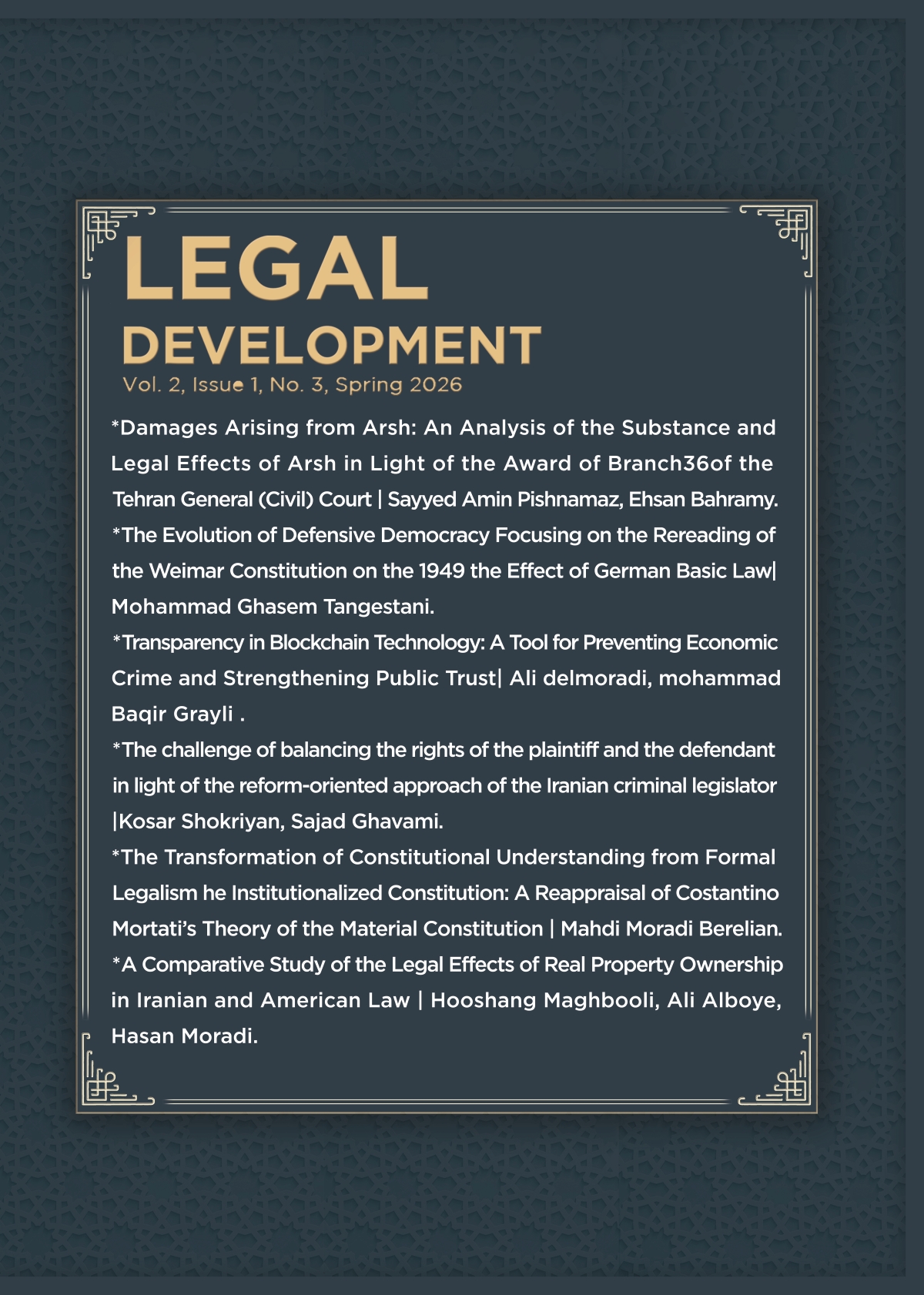
The challenge of balancing the rights of the plaintiff and the defendant in light of the reform-oriented approach of the Iranian criminal legislator

Articles in Press, Accepted Manuscript, Available Online from 30 January 2026

kosar shokriyan, sajad ghavami

Abstract In recent years, those involved in our country's judicial system have tried to benefit from new ‎scientific and empirical achievements in enacting criminal laws and regulations, paying special ‎attention to new developments in the fields of criminology and penal science. This attention, ‎especially in some areas, has led to the introduction of institutions such as suspension of ‎punishment, postponement of sentencing, and conditional release into the country's penal ‎system, with the influence of the teachings and discourses of international criminal law and ‎modern criminology. On the other hand, in some cases, our legislation, due to the influence of ‎Sharia and social requirements, has defined institutions such as pardon and repentance as tools ‎on the path of reform and rehabilitation of criminals. The main goal of these measures has been ‎to reform the behavior and rehabilitation of criminals, and the legislator has tried to guide the ‎country's penal system towards rehabilitation and reform, focusing on protecting the rights of ‎the accused. However, this focus has sometimes been such that the necessary balance between ‎the rights of the plaintiff and the accused has been disrupted. In such a way that some of the ‎rights of the plaintiffs of crimes have been weakened in the new laws and in some cases have ‎even been damaged. Therefore, it can be said that the recent criminal legislation has become a ‎law that protects the accused rather than creating a proper balance between the rights of the ‎parties. Ultimately, this trend reflects the challenge that legislators face; a challenge that requires ‎reviewing and creating a logical balance between the rights of the accused and the plaintiff so ‎that the country's criminal system, while maintaining justice, can also achieve the goals of ‎reform and rehabilitation.‎

The Transformation of Constitutional Understanding from Formal Legalism to the Institutionalized Constitution: A Reappraisal of Costantino Mortati’s Theory of the Material Constitution

Articles in Press, Accepted Manuscript, Available Online from 25 May 2026

Mahdi Moradi Berelian

Abstract The crisis of European constitutional law in the interwar period was not merely the collapse of parliamentarism or the failure of liberal states; rather, it was a crisis in the legal understanding of the constitution itself. The formal constitution, understood in the liberal tradition as a supreme legal document and an instrument for limiting power, lost its explanatory force in the face of mass parties, executive concentration, social polarization, and the transformation of sovereignty. This study aims to explain the emergence of the concept of the “material constitution” in interwar Europe and to analyze its relationship with the crisis of constituent power, the transformation of the state, and institutional order.
The study employs a descriptive-analytical method with a historical-conceptual approach. Costantino Mortati’s theory is reappraised within the theoretical field shaped by Hans Kelsen, Carl Schmitt, Rudolf Smend, and Hermann Heller, so that the constitution may be understood not merely as a text, but as the point of intersection between norm, power, institution, and society.
The findings show that Mortati’s theory, despite its connection with a historically and politically problematic context, provides a way beyond the simple dualism between Kelsenian normativism and Schmittian decisionism. For Mortati, the material constitution neither negates the formal constitution nor submits to the raw reality of power; rather, it refers to the institutional and social layer that sustains the constitutional text.The significance of the theory of the material constitution lies in revealing the gap between the written constitution and the institutional reality of power. It shows that a constitution without institutional and social support may remain formally valid yet practically ineffective. However, the material constitution can serve constitutionalism only when accompanied by the rule of law, separation of powers, fundamental rights, and accountability. Mortati’s main contribution is thus the opening of a path toward “institutionalized constitutionalism

The Concepts of Criminal Law and Criminology in Iranian Classical Literature

The Concepts of Criminal Law and Criminology in Iranian Classical Literature

Volume 1, Issue 1, Autumn 2025, Pages 30-53

Abbas Tadayyon

Abstract The rich and Persian multi-layered classical literature is not only an artistic and linguistic treasure, but also an unic source for interdisciplinary studies, especially in the fields of philosophy, sociology, and law. This article, with a critical and analyticaldescriptive approach, expands and deepens the analysis of the fundamental concepts of criminal law and criminology in a wide range of Iranian literary works. This research, beyond a superficial look, explores the roots and various dimensions of phenomena such as crime, punishment, justice, criminal responsibility, victimization, and crime prevention in literary texts and contrasts and comparasion them with contemporary criminological theories. From Ferdowsi's Shahnameh as the oldest document of national identity to Rumi's spiritual Masnavi as the pinnacle of mystical thought, and from Saadi's Golestan and Bustan as a school of practical ethics to the poems of Hafez and Obaid Zakani as symbols of social criticism, are explored. This article shows how Iranian classical literature has functioned as a historical criminology and reflected the profound views of a nation towards these phenomena.

The Role of Legal Moralism in the Criminalization Process with an Emphasis on the Iranian Legal System

The Role of Legal Moralism in the Criminalization Process with an Emphasis on the Iranian Legal System

Volume 1, Issue 1, Autumn 2025, Pages 132-147

Peyman Namamian, Amir Hossein Shakib Rad

Abstract This research examines the role of legal moralism as a fundamental criterion in the criminalization process, with a focus on the Iranian legal system. The present study was made by using a descriptive approach and library-based research and shows that perspectives in this field are largely divided between proponent and opponent. The proponent of legal moralism, consider morality as the foundation of social cohesion and emphasize on the necessity for lawmakers to protect it in order to strengthen social solidarity. In contrast, opponents, highlighting the relativity of morality and it's potential conflict with individual freedoms, view the imposition of moral principles through law as a threat to the effectiveness of the criminal system. In the Iranian legal system, given the principles of Sharia and the collective conscience, legal moralism occupies a prominent position; however, it's application must be based on logical, legal, social, and ethical criteria. This ensures that while individual rights and freedoms are protected, the moral values and norms of society are maintained and social stability and cohesion are guaranteed. Such a balanced approach allows for the coexistence of adherence to collective morality and the safeguarding of individual rights.

The Assassination of General Zahedi from the Perspective of International Human Rights Law

The Assassination of General Zahedi from the Perspective of International Human Rights Law

Volume 1, Issue 2, Autumn 2025, Pages 34-53

Misagh Bagheri, Moahamd Setayeshpur

Abstract This research aims to conduct a legal and human rights‑based analysis of the assassination of General Mohammad Reza Zahedi in the airstrike carried out by the Israeli regime against the consular section of the Iranian Embassy in Damascus. It seeks to examine this incident within the framework of peremptory norms of international law (jus cogens), the prohibition of the use of force, and States’ extraterritorial obligations to protect the right to life. The necessity of this study arises from the fact that extraterritorial targeted killings have emerged in recent years as a serious challenge to the international legal order, undermining the foundations of human rights and collective security. The central research question is: from the standpoint of the international human rights law system, which fundamental obligations does the assassination of General Zahedi violate, and how can the responsibility of the acting State be established? This study adopts a descriptive‑analytical approach, relying on international instruments, judicial and arbitral jurisprudence, United Nations reports, and legal doctrine. The findings indicate that the action constitutes a clear instance of arbitrary deprivation of life, a violation of the principle of non‑intervention, a breach of the inviolability of diplomatic premises, and a violation of Article 6 of the International Covenant on Civil and Political Rights (ICCPR). Moreover, it may be characterised as a form of State terrorism. The research concludes that the operation violated absolute and non‑derogable human rights obligations, exposes the acting State to international responsibility, and underscores the urgent need to strengthen legal accountability mechanisms at the international level.

<em>Evolution of Property Law in the Digital Context: EU Legal Doctrine and the Iranian Legal Approach</em>

Evolution of Property Law in the Digital Context: EU Legal Doctrine and the Iranian Legal Approach

Volume 1, Issue 2, Autumn 2025, Pages 2-33

setare Ayoubi, Sam Mohammadi, Seyyed Hasan Hosseini Moghaddam

Abstract One of the defining characteristics of the digital age is the accelerated pace of communication and the role of the Internet as the gravitational centre of global information. This connectivity, in addition to bringing individuals closer together, has enabled the interaction and overlap of various technologies, including social media algorithms and machine learning systems. These developments have led to fundamental transformations in the concept of property law. Digital property rights encompass access to and control over digital information, data, internet accounts, as well as contractual and intellectual property rights in the digital sphere. This study aims to examine the evolution of property law in the digital context within the European Union and to analyse its legal doctrine with a view to proposing solutions for the enhancement of digital property law in Iran. The research question is as follows: how have the policies and regulations
of the European Union and Iran concerning digital property evolved? The findings indicate that over the past two decades, EU policy on digital technologies has shifted from a liberal economic approach towards a legal doctrine grounded in digital currencies. This transformation arises from the emergence of the information society, which has created new opportunities and challenges for fundamental rights and democratic values. The adoption of the Regulation on Markets in Crypto-Assets (MiCA) in September 2020 exemplifies the EU’s effort to regulate and manage digital assets through legal frameworks. In contrast, Iran still lacks a clear legal framework for crypto-assets, and such assets are traded on the market without legal oversight. An examination of the EU’s legal doctrine can serve as a model for improving the Iranian legal system with respect to digital property. Conducted through a descriptive-analytical method, this study, while examining EU legal doctrine, offers recommendations for its adaptation to Iranian law.

The Limits and Legal Effects of the Powers of Secondary Agents in the Framework of Longitudinal agents Relationships

The Limits and Legal Effects of the Powers of Secondary Agents in the Framework of Longitudinal agents Relationships

Volume 1, Issue 1, Autumn 2025, Pages 118-131

Mehdi Taleghan Ghafari, Hamid Abhary, Mohammad Hossein Taghipour Darzi Naghibi

Abstract In the Iranian legal system, agency, as a consent contract , is subject to the client's consent and the limits of his powers. Based on general principles, the agent is obliged to be subject to this consent in all his actions, and any breaching it, can lead to the invalidity of the act and civil liability of the first (principal) agent. The results of the present study indicate that since, in the assumption of a longitudinal relationship between agents in secondary, the secondary agent is not appointed directly by the client, but through the first agent; therefore, the limits of his powers are a function of the powers of the first agent and are subject to the same amount of permission that the client has given to the first agent in the context of the power of agency. However, the author, using a descriptive-analytical method, seeks to identify and examine the limits and legal effects of the powers of agent in the framework of longitudinal agents' relationships in Iranian statutory law .

The University as an Actor in Environmental Criminal Policy: A Jurisprudential, Legal, and Criminological Approach

The University as an Actor in Environmental Criminal Policy: A Jurisprudential, Legal, and Criminological Approach

Volume 1, Issue 1, Autumn 2025, Pages 87-117

Hossein Ranjbar, Zeinab Majlesi

Abstract The Contemporary societies are confronted with complex environmental and social crises that demand integrated solutions. Such crises can only be addressed through the synthesis of three complementary approaches jurisprudential, criminal policy, and social prevention providing comprehensive and sustainable pathways toward intergenerational justice and the preservation of social order. This practical and descriptive–analytical study, inspired by verse 41 of Surah al-Rum (“Corruption has appeared on land and sea…”), combines jurisprudential principles, criminal policy frameworks, and social prevention strategies to propose a theoretical and practical foundation for innovative governance in the field of social prevention. Key questions explored include: How can jurisprudential teachings be applied to strengthen environmental criminal policy? What connections exist between jurisprudential rules such as Itlaf (destruction), Hifz al-Nizam (preservation of order), and La Darar (no harm) and social prevention policies? Finally, what role can universities, as fourth-generation institutions, play in socially preventing environmental crimes? Within the jurisprudential approach, rules such as Itlaf, Hifz al-Nizam, and La Darar are examined as normative and ethical foundations. The criminal policy approach emphasizes the criminalization of destructive behaviors and the design of both penal and non-penal sanctions. The social prevention approach highlights universities as fourth-generation institutions engaged in scientific monitoring, social responsibility, and reducing criminogenic conditions. Data collection relied on library and documentary methods, with analysis of jurisprudential, legal, and criminological sources. Findings suggest that the synergy of these three approaches can provide a coherent framework for reducing environmental and social crimes, advancing intergenerational justice, and strengthening social capital.

The Developments of Formalism in Transactions of Immovable Properties in Civil Law System, Jurisprudence and Iranian Law

The Developments of Formalism in Transactions of Immovable Properties in Civil Law System, Jurisprudence and Iranian Law

Volume 1, Issue 1, Autumn 2025, Pages 8-29

Ahmad Esfandiari

Abstract The opposition of formalism- which the registration of documents related to transaction is one of it's manifestations- to the principle of the consensualism in contracts, reveals only part of it's role in the contemporary law in civil law countries, and the allegation that a simple exchange of creative intention is sufficient to create a contract also accounts for only part of the positive law. To discover the importance of formalism, one must go beyond the analysis of the rules relating to the formation of contracts. Despite the establishment of the principle of consent in contracts, formalism plays an important role in contemporary law and is also a complemention to it. In Islamic jurisprudence, the focus of jurists was mainly on the expression of the intention of the contract by method other than writing, especially by words. Some even considered words to be a constituent element of the contract and something substantial that can be compared to the mandatory formalism in Roman law. However, only a group of later jurists, accepted the use of writing to express intention in rare cases without the parties being obliged to do so. Although there is no position for writing in legal acts in civil law, in negotiable instruments law, transactions made on a instrument must necessarily be in writing and the Registration of Documents and Real Estate act, as well as the Hesbi Affairs act, have also emphasized the need to use writing in some legal acts such as peace agreements, gift agreements, wills, etc. In Iranian legal regulations, which it is emphasized on the writing of legal acts, the role of registration is a complementary aspect and the principle of consensuality of legal acts as well as the constructive role of the intention has never been denied in them.

Keywords Cloud